Showing posts with label apologetics. Show all posts

Tuesday, March 10, 2026

The Jesus Discoveries by Jeremiah J. Johnston

Book cover
The Jesus Discoveries
by Jeremiah J. Johnston


ISBN-13: 9780764243660
Paperback: 176 pages
Publisher: Bethany House Publishers
Released: March 10, 2026

Source: ebook review copy from the publisher through NetGalley.

Book Description, Modified from Goodreads:
In this eye-opening, faith-fortifying book from acclaimed New Testament scholar and minister Jeremiah Johnston, you'll encounter ten of the most compelling historic finds that corroborate the truth claims found in the Bible regarding who Jesus said he was, when and where He lived, His claims and aims, how His life ended, and how that wasn't the end of His story.


My Review:
The Jesus Discoveries is an apologetics book about Jesus. While the author feels that these are "ten of the most compelling" finds that align with the descriptions of Jesus given in the gospels, several of the finds seemed a bit indirect to be very mind-changing to a skeptic. I've read other apologetic books on the historical existence of Jesus that were more convincing, so I'm unlikely to choose this book to give to a skeptic, but I did find it an interesting read.

The ten historic finds are: the shroud of Turin, magic phrases on pottery that might mention Christ, the James ossuary (with the "James, son of Joseph, brother of Jesus" inscription), early mentions by skeptics about Jesus, a stone inscription mentioning Pontius Pilate, the "King of the Jews" crucifixion inscription being consistent with Roman practice, ancient fragments of the New Testament, the Palatine Graffito (a donkey-headed man being crucified while a young man worships him), Josephus' mention of Christians in his writings, and the Dead Sea scrolls.

The shroud was cited first, but much of that chapter talked about why the reader should look at the latest evidence on the shroud. A later, "Dig Deeper" section about the shroud contained most of the evidence that convinced the author that the shroud really was used on Jesus. In the next chapter, he gave details about ancient magical amulets and cups which may reference Christ (or might be using a different name). This supposedly shows that people widely knew Jesus' ability to do miracles, but it's not even certain they refer to the Jesus of our gospels. The Palatine Graffito appears to be a reference to Christians worshiping a crucified god, but this shows more what pagans thought about Christians than anything else. As in, most of the chapters are really only significant if you already believe the Bible account.


If you've read this book, what do you think about it? I'd be honored if you wrote your own opinion of the book in the comments.


Monday, May 10, 2021

The Christ Files with John Dickson

Book cover
The Christ Files
by John Dickson


MasterLectures Video
Publisher: Zondervan Academic
Source: Free month offer from MasterLectures.

Video Series Description:
In The Christ Files, historian Dr. John Dickson sets out to discover what we can know for certain about the life of Jesus. In a captivating journey across the globe, this series examines ancient documents and consults the world’s most respected historians and scholars. Filmed in seven countries, the documentary reveals the earliest and most important manuscript evidence for Jesus of Nazareth, including the writings of Josephus, Tacitus, the apostle Paul and the controversial Gnostic Gospels. The Christ Files provides viewers with a front row seat to the facts behind Western civilization’s most influential story.


My Review:
Each episode was 21-22 minutes long.

The Christ Files is a video series that examines the question of how certain we can be about the accuracy of the accounts about Christ in the Bible. The host went to different places around the world to talk with experts about this topic. The series examined ancient documents that mention Jesus and what we can learn from them about Jesus. We learned about writings from various cultures, and the host explained how cultural aspects further build assurance in the biblical account. For example, several sources showed that it would be hard to convince a Roman (among others) that someone who died on a cross was worth worshiping, yet Romans became Christians. The speaker was easy to listen to and understand. Overall, I'd recommend this series.

Session 1: Gnostics and Romans: How the ancient world viewed Jesus of Nazareth
Session 2: Jews and Christians: Jesus according to his own people
Session 3: Lost Sources and Oral Traditions
Session 4: Archaeologists and Artifacts: Piecing together the world of Jesus


If you've read this book, what do you think about it? I'd be honored if you wrote your own opinion of the book in the comments.


Monday, September 28, 2020

Demolishing Supposed Bible Contradictions, Volume 2 by Bodie Hodge

book cover
Demolishing Supposed Bible Contradictions, Volume 2
Editors: Ken Ham,
Bodie Hodge,
Tim Chaffey


ISBN-13: 9780890516492
Paperback: 174 pages
Publisher: New Leaf Publishing Group
Released: March 28th 2012

Source: Bought.

Book Description, Modified from Goodreads:
Over 40 powerful explanations proving the Bible is still accurate and without error! Can God be Tempted? Why don't Christians follow all the Old Testament laws? Is marriage good or bad? All these and more are questions that appear to point out a problem in the biblical text. Too often people focus on what seems to be contradictions or errors in the Bible, using them to create doubt in the minds of believers or act as stumbling blocks in trying to present the Gospel. It is important to resolve these issues to reassure people that the Bible is inerrant.


My Review:
Demolishing Supposed Bible Contradictions, Volume 2 is a collection of answers written by various people explaining why various alleged contradictions in the Bible aren't actual contradictions. The book explained what, exactly, a contradiction is and why these alleged contradictions aren't true contradictions (like the word is used in a difference sense in different places or the dilemma wasn't an either/or but both are possible). They explained the answer or several possible answers to the specific alleged contradictions. The arguments were easy to follow and well-written. I'd highly recommend this book, especially to anyone who has been asked about (or wondered about) apparent contradictions in the Bible and didn't know the answer.


If you've read this book, what do you think about it? I'd be honored if you wrote your own opinion of the book in the comments.


Excerpt: Read an excerpt using Google Preview.

Monday, February 24, 2020

Footprints in the Ash by John D. Morris

book cover
Footprints in the Ash
by John D. Morris


ISBN-13: 9780890514009
Hardcover: 128 pages
Publisher: Master Books
Released: August 19th 2004

Source: Bought the book.

Book Description from Goodreads:
In the aftermath of the Mount St. Helens eruption and the subsequent glacier slide and mudflows, there remained a geologic gold mine for earth scientists. No natural disasters in recent history could compare with the variety of process which resulted from this tectonic and volcanic event. As creation scientists have carefully studied this geological phenomenon, they have concluded that Mount St. Helens accomplished the same sort of geologic work that biblical creationists attribute to Noah's flood. While this explosion was certainly much smaller in scale and intensity, many lessons were learned through this occurrence that help us understand the unobservable past. Journey back to this catastrophic event with scientists Dr. Steve Austin and Dr. John Morris and see what was discovered as they reconstruct the sequence of earthquakes, eruptions, avalanches, mudflows, and other geologic processes and unveil their fascinating research findings!


My Review:
Footprints in the Ash talks about how observations of events during and after the explosion of Mount St. Helens impact our understanding of how quickly various geological formations are created. The book had many photographs of the destruction and of the geological formations that were created in the aftermath. The author started by detailing the events of the eruption, like the start of the mud flow or the various catastrophic events that happened at Spirit Lake.

The author then moved on to the observations taken by the scientists at that time and in the years afterwards. He talked about how a certain sedimentation pattern or whatever would be explained if seen in places like the Grand Canyon, but we now know how quickly they form because we saw them form in a matter of hours or sometimes days.

He talked about rapid strata formation, rapid hardening of sediments into rock, rock deformation, the damage caused by flowing water and mud slurry, radioisotope dating on the new lava dome, rapid erosion of canyons into solid rock, rapid formation of Badlands topography, comparing it to the Grand Canyon, the rapid formation of peat and coal beds, the rapid formation of shoreline features, the rapid fossilization of trees and about petrified wood, and how quickly plants and animals returned to the ash areas. Overall, I'd recommend this very interesting book.


If you've read this book, what do you think about it? I'd be honored if you wrote your own opinion of the book in the comments.


Thursday, February 20, 2020

Searching for Truth by Tim Chaffey, Colin Dyer

book cover
Searching for Truth
by Tim Chaffey,
Colin Dyer (Illustrator)


ISBN-13: 978-1683440338
Paperback: 72 pages
Publisher: Master Books
Released: April 15th 2017

Source: Bought the book.

Book Description, Modified from Goodreads:
In a cultural climate that exalts personal preference above all else, here is a dramatic, visually stunning story that addresses issues and concerns of utmost importance as life meets truth. Discover why the Bible can be trusted as God’s Word, including its prophetic revelations, evidence of the supernatural, consistency over time, and the scientific and historical accuracy of its text. What makes the Bible unique and its account of truth different from all other religious writings is discussed through thought-provoking questions.


My Review:
Searching for Truth is a graphic novel. It uses a simple fiction story to present the gospel and some reasons to believe Christianity. Several college students are taking a course on world religions and get into a discussion about why one of them still believes in Christ. They bring up objections to Christianity that the professor has given, and the Christian provide a response. They cover topics like: are there errors in the Bible, is the Bible an accurate copy of the originals, is it scientifically and historically accurate, etc. They cover some of the evidence for the Bible, then the gospel is presented and one of the characters accepts Christ. The illustrations were colorful and realistic in style, and the comic format was quick and easy to read. Overall, I'd recommend this for tweens, teens, and adults who like this style.


If you've read this book, what do you think about it? I'd be honored if you wrote your own opinion of the book in the comments.


Excerpt: Read an excerpt using Google Preview.

Saturday, May 25, 2019

The Logic of God by Ravi Zacharias

book cover
The Logic of God
by Ravi Zacharias


ISBN-13: 9780310454038
Hardcover: 320 pages
Publisher: Zondervan
Released: April 2, 2019

Source: review copy from the publisher through BookLook.

Book Description, Modified from Goodreads:
In his first ever devotional, apologist Ravi Zacharias offers 52 readings that explain how and why Christianity, the Bible, and God are still relevant, vital, and life-changing for us today. To all our dilemmas Ravi says, "I am convinced that Jesus Christ alone uniquely answers the deepest questions of our hearts and minds." With a deep understanding of the questions that trouble our hearts, Ravi makes profound biblical truth easy to understand. And if your life is busy, this book is designed for you! It addresses 52 topics that you can read over the course of one year or slowly digest at your own pace. Each entry includes a Scripture, questions for reflection, and some practical application steps.


My Review:
The Logic of God is a 52 day devotional. The author suggested that you read one entry each week, but you can use it as a daily devotional. Each entry started with a verse followed by 2-4 pages of commentary and ended with 4 questions (2 about the text and 2 about applying the lesson to your life). The book was about what's important to God and why belief in God is reasonable. The title is a bit misleading as the focus wasn't really on logic. There were some arguments defending the Christian faith, but even then it's more focused on thinking about the person asking the question than the questions themselves. It was aimed at those who already believe rather than being something you'd hand to a non-Christian. The author talked about events he attended or that happened in his life as a way to illustrate or make a point. Overall, I'd recommend this devotional to those who want some substance in a short devotional format.


If you've read this book, what do you think about it? I'd be honored if you wrote your own opinion of the book in the comments.


Excerpt: Read an excerpt using Google Preview.

Monday, January 15, 2018

Evidence That Demands a Verdict by Josh McDowell, Sean McDowell

book cover
Evidence That Demands a Verdict
by Josh McDowell,
Sean McDowell


ISBN-13: 9781401676704
Hardcover: 880 pages
Publisher: Thomas Nelson
Released: Oct. 3, 2017

Source: Review copy from the publisher through BookLook.

Book Description, Modified from Goodreads:
The modern apologetics classic that started it all is now completely revised and updated—because the truth of the Bible doesn’t change, but its critics do. With the original Evidence That Demands a Verdict, bestselling author Josh McDowell gave Christian readers the answers they needed to defend their faith against the harshest critics and skeptics. Since that time, Evidence has remained a trusted resource for believers young and old. Bringing historical documentation and the best modern scholarship to bear on the trustworthiness of the Bible and its teachings, this extensive volume has encouraged and strengthened millions. Now, with his son Sean McDowell, Josh McDowell has updated and expanded this classic resource for a new generation. This is a book that invites readers to bring their doubts and doesn’t shy away from the tough questions.

Features Include:
• Thoroughly revised and updated from the previous edition
• All-new chapters defending against the latest attacks from Christianity’s critics
• Designed to be a go-to reference for even the toughest questions
• Offers thoughtful responses to the Bible’s most difficult and extraordinary passages
• Expansive defense of Christianity’s core truths, including the resurrection of Jesus Christ


My Review:
Evidence That Demands a Verdict is a collection of evidence that helps believers have confidence and unbelievers see that there is a reasoned, factual basis to Christianity. I've owned previous editions of this book, the latest being the 1999 version. This book has been updated to include the latest discoveries and arguments as well as commentary at the beginning from Sean McDowell. While much of the core evidence is the same, there has been some rewriting and changes made as the new information was added. Even if you've read the previous versions, it's worth getting this version for the new material. I'd highly recommend this as a great reference resource (for looking up information that interests you) or to read through from start to finish.

The book covered why we believe that there is a god (evidence for theism), ways that the Bible is unique from other books, how the Bible was written, manuscript and archeological evidence that the New and Old Testaments are accurate, how the text of the Bible was copied by scribes and how accurate they were, information about the Gnostic gospels and other texts that were not included in the Bible and why they weren't included. Christian and non-Christian sources and archeological discoveries that support the existence of Jesus, examining Jesus' claims to deity and does that make him lord, liar, or lunatic. Old Testament prophecies that Jesus fulfilled, evidence for Jesus' literal, bodily resurrection, and why the apostles were willing to die. How the Old Testament and ancient near eastern texts are similar but also strikingly different, evidence for the historical reliability of Genesis (Adam and Eve, the patriarchs), Exodus, the conquest, the united monarchy, the divided monarchy, the exilic period, and other books of the Old Testament (Pentateuch, Isaiah, Daniel). Some alleged contradictions in the Bible and how they can be harmonized. Why truth matters, can you know the truth, answering skeptics, are miracles possible, and many other topics.


If you've read this book, what do you think about it? I'd be honored if you wrote your own opinion of the book in the comments.


Excerpt: Read an excerpt using Google Preview.

Monday, May 8, 2017

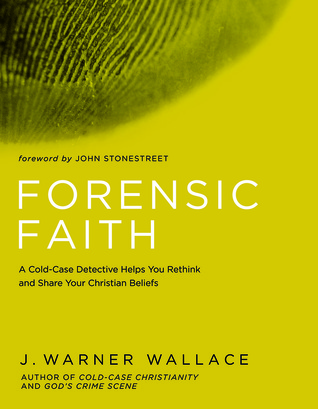
Forensic Faith by J. Warner Wallace

book cover
Forensic Faith
by J. Warner Wallace


ISBN-13: 9781434709882
Paperback: 304 pages
Publisher: David C Cook
Released: May 1, 2017

Source: ebook review copy from the publisher through NetGalley.

Book Description, Modified from NetGalley:
Forensic Faith will help readers: understand why they have a duty to defend the truth, develop a training strategy to master the evidence for Christianity, learn how to employ the techniques of a detective to discover new insights from God’s Word, and become better communicators by learning the skills of professional case makers.

With real-life detective stories, fascinating strategies, and biblical insights, Wallace teaches readers cold-case investigative disciplines they can apply to their Christian faith.


My Review:
Forensic Faith explains why Christians need to learn the evidence supporting the Christian faith and teaches some basic apologetics skills. The first part of the book made the case for why it's important not to just have blind faith that Christianity is true but to understand the evidence that confirms it's true and to build your skill at sharing this information.

Many Christian kids are losing their faith due to unanswered questions, yet the answers are out there. We need to train our kids (and adults) with the answers. Training involves practice, and the author described how he's done this with youth groups. I totally agree that kids should be taught the evidence and the skill to share it. I taught myself some of this way back when I first went to college, and it made a huge difference.

The author was a cold-case detective. In the second part of the book, he explained how skills he used as a detective can be applied to spotting evidence for Christianity and using this evidence to make a case for it. A lot of this information was from (and covered in greater detail in) his previous two books. If you've read those books, you're probably already convinced that it's important to learn and share the evidence for Christianity, but you might still be interested in his suggestions on how to train youth groups or on using the evidence to "make a case" when asked why you believe. However, I'd mainly recommend this book to Christians who aren't very familiar with the evidence supporting their faith.


If you've read this book, what do you think about it? I'd be honored if you wrote your own opinion of the book in the comments.

Thursday, May 4, 2017

Answering Jewish Objections to Jesus, Vol 5 by Michael L. Brown

book cover
Answering Jewish Objections to Jesus, Vol 5
by Michael L. Brown


ISBN-13: 9781881022862
Paperback: 353 pages
Publisher: Purple Pomegranate Productions
Released: Nov. 5, 2015

Source: Bought from a store.

Book Description, Modified from Goodreads:
In the fifth and final volume of his series, Answering Jewish Objections to Jesus, Dr. Michael Brown refutes the traditional Jewish concept that there is a binding, authoritative Oral Law going back to Moses. While showing great respect for his people's traditions, Brown demonstrates that when there is a conflict between the Bible and tradition, Jews are called to follow the Bible.


My Review:
Answering Jewish Objections to Jesus, Vol 5 "refutes the traditional Jewish concept that there is a binding, authoritative Oral Law going back to Moses." The author wrote as if talking directly to a traditional Jew who believes in the Oral Torah. He started each section with a defense commonly given for the Oral Law, then he described why this defense isn't convincing or accurate.

I'm not a Jew and was simply interested in learning what the Oral Torah referred to. Since the author assumed that the reader is well informed about the Oral Torah, my questions weren't directly answered. However, I did get an idea of what it is, how it developed, and what traditional Jews think about it.

The author was very detailed and exhaustive in his responses, looking at example after example. That's good if you're talking with someone who knows all of the counter-arguments, but it's more than I can easily remember if I wanted to argue the case myself. Still, I do remember many of the overall points he made. I suspect it's a good book in terms of doing what the author intended. However, I'm wondering just how many people who are that devoted to the Oral Torah would be open to reading his arguments.


If you've read this book, what do you think about it? I'd be honored if you wrote your own opinion of the book in the comments.


Tuesday, March 21, 2017

The Dawn of Christianity by Robert J. Hutchinson

book cover
The Dawn of Christianity
by Robert J. Hutchinson


ISBN-13: 9780718079420
Hardcover: 352 pages
Publisher: Thomas Nelson
Released: March 14, 2017

Source: Review copy from the publisher through BookLook.

Book Description, Modified from Goodreads:
The Dawn of Christianity tells the story of the last week of Jesus' life and the first few years after his death and resurrection. Using the most recent studies by top Christian and secular scholars, Robert Hutchinson reconstructs all of the known accounts of the witnesses to the resurrection and the initial years afterward, when they spread the word about what they had witnessed.


My Review:
The Dawn of Christianity is a "narrative retelling" of the last week of Jesus' life and of the first few years after his death and resurrection. The author used direct quotes from the Bible, summarized what happened, or created a fictional narrative of what might have happened. However, this is a commentary rather than pure narrative.

While talking about events, the author provided information about the political situation of the time and archeological discoveries. For example, he described what the temple looked like and the likely location of the crucifixion along with details about crucifixion. The author also talked about what skeptics of the Bible have thought and now think about various passages.

While he usually said "some skeptics doubted" or similar phrases, a few times he said "scholars doubted"--like anyone who believed the accuracy of the Bible couldn't be counted as a scholar. He also tried to explain away the supernatural elements. If Jesus raised someone from the dead, that person wasn't really dead but asleep and Jesus just revived them. (Happily, Jesus' resurrection was not explained away using this argument.) According to the author, Jesus just assumed that anyone criticizing the system would end up dead--yet he held out hope he'd avoid death and considered running away to a foreign country. He also had Jesus secretly arranging things like the use of the donkey and the Upper Room and keeping this information from his closest followers for security reasons.

The part about the first few years of the early church was mostly a summary of events described in Acts along with some political background information. The commentary effort was mostly spent on the events right before and after the crucifixion. There are plenty of books that cover that material and do so in a way that's easier to read (as this had a more academic tone).


If you've read this book, what do you think about it? I'd be honored if you wrote your own opinion of the book in the comments.


Excerpt: Read an excerpt using Google Preview.

Sunday, August 21, 2016

Cold-Case Christianity by J. Warner Wallace

book cover
Cold-Case Christianity
by J. Warner Wallace


ISBN-13: 9781434704696
Trade Paperback: 288 pages
Publisher: David C. Cook
Released: Jan. 1, 2013

Source: Bought from Christianbook.com.

Book Description from Goodreads:
Written by an L. A. County homicide detective and former atheist, Cold-Case Christianity examines the claims of the New Testament using the skills and strategies of a hard-to-convince criminal investigator.

Christianity could be defined as a “cold case”: it makes a claim about an event from the distant past for which there is little forensic evidence. In Cold-Case Christianity, J. Warner Wallace uses his nationally recognized skills as a homicide detective to look at the evidence and eyewitnesses behind Christian beliefs. Including gripping stories from his career and the visual techniques he developed in the courtroom, Wallace uses illustration to examine the powerful evidence that validates the claims of Christianity. A unique apologetic that speaks to readers’ intense interest in detective stories, Cold-Case Christianity inspires readers to have confidence in Christ as it prepares them to articulate the case for Christianity.


My Review:
Cold-Case Christianity looks at the claims of the gospels from the point of view of a cold case detective. The author looked at many "lines of evidence" as he examined the gospels, and I felt he did an excellent job of explaining how he came to his conclusions. He even covered some angles that I haven't read before and which I found very interesting.

He began by using examples of various cases he's worked on to show how a detective examines evidence. He then applied these methods to the evidence surrounding the claims of the gospels. Then he looked at some of the evidence in greater detail. He looked at when the gospels were written, if they are eyewitness accounts, if they are accurate, how well these accounts have been preserved over time, what the motive was behind writing the gospels, and how much evidence is "enough."

I wouldn't hesitate to give this book to anyone who is uncertain about the gospels or who likes to debate these issues. This book will especially appeal to those who are interested in detective work.


If you've read this book, what do you think about it? I'd be honored if you wrote your own opinion of the book in the comments.


Excerpt: Read an excerpt using Google Preview.

Monday, June 27, 2016

A Doubter's Guide to the Ten Commandments by John Dickson

book cover
A Doubter's Guide to the Ten Commandments:
How, for Better or Worse, Our Ideas about the Good Life Come from Moses and Jesus
by John Dickson


ISBN-13: 9780310522591
Trade Paperback: 304 pages
Publisher: Zondervan
Released: June 7, 2016

Source: Review copy from the publisher through BookLook.

Book Description, Modified from Back Cover:
The Ten Commandments are perhaps some of the most well-known and vexed verses of the whole Bible. They have found their way into our art, monuments, literature, and culture—even into Richard Dawkins famed “Ten Atheist Commandments.”

In A Doubter’s Guide to the Ten Commandments, bestselling author John Dickson explores how these ten verses have changed our world and how they show us what the Good Life looks like. Whether or not one believes in the Bible, these ten ancient instructions open up a window to the Western world and on our own soul.


My Review:
A Doubter's Guide to the Ten Commandments talks about how the Ten Commandments--and Jesus' take on them in the New Testament--have deeply influenced history and Western culture. The author assumed that his reader isn't Christian and maybe not even religious, so he described the original context of each commandment, what Jesus said about the commandment, and how these ideas have affected the culture in the past and present.

The author was respectful towards those who do not share his Christian faith and used language that anyone should be able to follow (rather than "Christian-ese" or academic language). Though I knew much of this information, I still found it an interesting read and learned a few things. Overall, I'd recommend this book to anyone who is interested in the topic.


If you've read this book, what do you think about it? I'd be honored if you wrote your own opinion of the book in the comments.


Excerpt: Read an excerpt using Google Preview.

Thursday, October 8, 2015

Thank God for Atheists by Timothy Morgan

book cover
Thank God for Atheists
by Timothy Morgan


ISBN-13: 9780736966283
Paperback: 288 pages
Publisher: Harvest House Publishers
Released: October 1, 2015

Source: ebook review copy from the publisher through NetGalley.

Book Description, Modified from Goodreads:
After a decade of major disappointments, Timothy Morgan was ready to reject God. Atheism offered an escape--an opportunity to dismiss God permanently. But as Morgan delved into the thinking of great atheists past and present, he was stunned. In book after book, he found their reasons for rejecting God to be intellectually unfulfilling.

In Thank God for Atheists he candidly shares his journey by letting atheists speak for themselves, examining their logic to see whether it holds up or not. You'll find this a personal and thoughtful book on why the evidence for God is much more compelling than the evidence against Him.


My Review:
Thank God for Atheists is an apologetics / worldview comparison book. It's a book that I can honestly see both atheists and Christians finding interesting. The author made every effort to accurately summarize the views of the atheists that he discussed in this book (Friedrich Nietzche, Bertrand Russell, Sam Harris, Richard Dawkins). He offered the living authors the chance to read his summary of their views and comment on it (which Dawkins did), and he asked atheist groups to do the same with his summaries of the dead authors.

The author started by explaining his Christian upbringing and why he started looking for convincing reasons to believe God doesn't exist. Then he discussed the long history of skeptical thought--the people throughout history and the world who questioned the religions of their area. He took four authors that he thought best expressed the arguments for atheism and who came at it from somewhat different angles. He provided a short biography for the author, summarized his views, then addressed those arguments. If several authors had the same argument, he picked the one who expressed it the best and only responded to it once.

I felt that the author did a good job of explaining why he didn't find these views logically compelling even though he wanted to be convinced. His writing was concise and his reasoning was easy to follow. I appreciated his respectful tone as people are more likely to listen when they feel like their view has been correctly heard and respectfully considered. I didn't always share his exact views, but I felt he did a good job of representing why Christians (and others) can find atheist arguments unconvincing. I'd highly recommend this book to those who want to dig deeper into the arguments for both sides.


If you've read this book, what do you think about it? I'd be honored if you wrote your own opinion of the book in the comments.


Excerpt: Read an excerpt using Google Preview.

Monday, September 7, 2015

The Atheist Who Didn't Exist by Andy Bannister

book cover
The Atheist Who Didn't Exist
by Andy Bannister


ISBN-13: 9780857216106
Trade Paperback: 192 pages
Publisher: Monarch Books
Released: July 27, 2015

Source: Review copy from the publisher.

Book Description, Modified from Christianbook.com:
Blending humor with serious thought, The Atheist Who Didnt Exist will help readers to think a little deeper about the popular claims of atheism. Whether the reader is a Christian who desires to be able to start a conversation with secular friends or simply an agnostic dissatisfied with some of the arguments that pass for serious thought, Andy Bannister shows that when it comes to the most important questions of life, we need to move beyond simplistic sound bites.


My Review:
The Atheist Who Didn't Exist is a Christian apologetics book. The purpose is to point out the problems with 'bad argument' sound bits for atheism so that Christians and Atheists can carry on a more thoughtful dialogue. The author took an atheist claim and rephrased it in another context so that it was easier to see how the argument held up. He started each chapter with a silly story that illustrated the argument in the new context, then he explained why it isn't a good argument.

I think he did a good job of showing why the arguments don't work. However, I can't use his stories to make a similar argument since he personalized them. I'd have to think a while to figure out how to explain his argument to someone else (which may be a good thing).

The author's humor won't be for everyone. It's mainly teasing about things few Americans have any stake in (like English sports teams that don't do well). However, the author sometimes went beyond silly stories and teasing. He poked fun at Dawkins, for example, not just Dawkins' bad arguments. That bothered me. Christians are supposed to be known for their loving attitudes, and I doubt Dawkins is feeling the love.

There are references to drinking alcohol and a few uses of bad language, which will turn off some Christians. Overall, I liked the method the author used to illustrate the problems with certain atheist arguments. However, I'm doubtful that the author's brand of humor would help in explaining the point to an atheist who takes those arguments seriously.


If you've read this book, what do you think about it? I'd be honored if you wrote your own opinion of the book in the comments.


Excerpt: Read an excerpt using Google Preview.

Friday, August 7, 2015

God's Crime Scene by J. Warner Wallace

book cover
God's Crime Scene
by J. Warner Wallace


ISBN-13: 9781434707840
Paperback: 320 pages
Publisher: David C. Cook
Released: August 1, 2015

Source: ebook review copy from the publisher through NetGalley.

Book Description, Modified from Back Cover:
Join J. Warner Wallace, former atheist and seasoned cold-case detective, as he tackles his most important case ... with you on the jury!

There are four ways to die, and only one of them requires an intruder. Suicides, accidental, and natural deaths can occur without any evidence from outside the room. But murders typically involve suspects external to the crime scene. If there’s evidence of an outside intruder, homicide detectives have to prepare for a chase. Intruders turn death scenes into crime scenes.

Using his expertise as a cold-case detective, J. Warner examines eight critical pieces of evidence in the “crime scene” of the universe to determine if they point to a Divine Intruder. If you have ever wondered if something (or someone) outside the natural realm created the universe and everything in it, this is the case for you.


My Review:
God's Crime Scene is an apologetic book that looks at evidence about the origins of the universe from the point of view of a cold case detective. Does the universe (including the earth, humans, and even their minds) show evidence of outside tampering or can the evidence be explained in purely naturalistic terms?

The author looked at many "lines of evidence" (cosmology, biology, etc.) as he examined the case. I felt he did an excellent job of distilling the arguments down to explanations that non-scientists can understand. He quoted people from all sides of the debate, and he presented a wide range of possible explanations in the process of finding which one best fit the evidence.

He used examples of various cases he's worked on to show how a detective examines evidence to determine if it's from an outside source and who is responsible. He then applied these methods to the evidence found in the universe. This helped to illustrate his points so I could more easily understand his reasoning.

He only examined whether there was a Divine Intruder or not and, if so, what the evidence can tell us about this intruder. He did not attempt to argue who the Divine Intruder might be. He has another book that examines the Christian Bible to see if it's trustworthy evidence, and it's a good companion book with this one. I wouldn't hesitate to give this book to anyone who is uncertain if there is a god or not. It's also a good resource for people who like to debate this sort of thing with atheists and agnostics. This book will especially appeal to those who are interested in detective work.


If you've read this book, what do you think about it? I'd be honored if you wrote your own opinion of the book in the comments.


Excerpt: Read an excerpt using Google Preview.

Tuesday, July 28, 2015

How We Got The Bible by Timothy Paul Jones

book cover
How We Got The Bible
by Timothy Paul Jones, PhD


ISBN-13: 9781628622164
Paperback: 184 pages
Publisher: Rose Publishing
Released: July 16, 2015

Source: ebook review copy from the publisher.

Book Description from Amazon:
Have you ever wondered who wrote the books in the Bible and how they ended up together? Has anyone ever told you that some books were cut out of the Bible or that the stories of Jesus in the Gospels can t be trusted? In this book, dive into the fascinating account of the most amazing and best-preserved book the world has ever seen. Dr. Timothy Paul Jones gives easy-to-understand answers to popular questions on the Bible s reliability and accuracy. Includes:

1. How the Old Testament and New Testament came to us

2. Definitions of popular terms such as inspired, inerrant and infallible

3. Reasons the New Testament books were chosen

4. Compelling stories behind Polycarp, Serapion, John Wycliffe, William Tyndale, the King James Version of the Bible and more!

5. Fascinating facts about the Bible such as: there are more than 5,700 surviving manuscripts from the New Testament compared to 210 surviving copies of Plato.


My Review:
How We Got The Bible described how the Bible was written, copied, translated, and basically how we got the Bible that we use today. It's written from a conservative, Protestant viewpoint. Not only did the author explain how we got the Bible, but he dealt with some common claims that skeptics make. He showed that the Bible is trustworthy. This book was easy to read and to follow, and it used charts to help break down some ideas for quick reference.

This book is intended for Christians who want to know more about the origins of the Bible. It's part of a larger DVD group study on the topic (though the book stands on its own). It did a good job of giving a solid, basic overview of the topics covered. Christians who wish to debate skeptics on these topics will probably need to read a more in-depth book, but I'd recommend this as a relatively quick read for Christians who simply want the basics.


If you've read this book, what do you think about it? I'd be honored if you wrote your own opinion of the book in the comments.


Monday, June 22, 2015

Alive by J. Warner Wallace

book cover
Alive: A Cold-Case Approach to the Resurrection
by J. Warner Wallace


ISBN-13: 9780781411288
ebook: 36 pages
Publisher: David C Cook
Released: March 1st 2014

Source: ebook bought on Christianbook.com.

Book Description, Modified from Goodreads:
The resurrection. As far as doctrines go, it's a game changer. What if we assessed the issue of the resurrection as a cold case detective would evaluate a crime scene? Author J. Warner Wallace is a cold-case detective. He also used to be an atheist. Follow along in this brief presentation of his approach in applying his detective's expertise to the accounts of the resurrection. Wallace believes the case is compelling.


My Review:
Alive is a short apologetic booklet that looks at the evidence surrounding Jesus' resurrection from the point of view of a cold case detective. What is the most reasonable explanation for the accounts found in secular, historical sources and in the Bible?

The author explained his process and then examined the possible explanations using his experience as a cold case detective. He did a good job of covering the various, possible scenarios surrounding the crucifixion and resurrection. His reasoning was easy to follow and rational. Overall, this would be a good resource for those who are uncertain about Jesus' resurrection and only have time for a quick read. It will especially appeal to those who are interested in detective work. However, this will be too brief for anyone wanting a thorough, deep look on the subject.


If you've read this book, what do you think about it? I'd be honored if you wrote your own opinion of the book in the comments.


Excerpt: Read an excerpt using Google Preview.

Saturday, November 22, 2014

Censored Science by Bruce Malone

book cover
Censored Science:
The Suppressed Evidence by Bruce Malone


ISBN-13: 9780971591158
Hardcover: 110 pages
Publisher: Search for the Truth Ministries
Released: January 1, 2009

Source: Review copy received through a publicist.

Book Description, Modified from Goodreads:
Censored Science is a stunning designed, full-color book showcasing the fifty best evidences for a biblical creation worldview. Each two-page spread lays out the evidence for creation and then provides a rebuttal to the most common evolutionist objections to the evidence. The book is divided into three major sections - Censored Biological Evidence, Censored Geological Evidence, and Censored Cosmological Evidence.

Rather than a simple presentation of facts, Censored Science draws the reader into each subject using stories, analogies, and illustrations of the relevance for each of the evidences for creation. It has been technically reviewed and endorsed by some of the top scientists involved in creation research - including Dr. Steve Austin, Dr. John Baumgardner, and Dr. John Sanford.


My Review:
Censored Science is a coffee-table style book discussing 50 different problems with evolution and how the Biblical record (i.e. 6 days for creation and a world-wide flood) better explains the evidence. The book is full of colorful pictures. The text tends to summarize the information rather than give a fuller explanation, so this book is better for readers who prefer an overview. The author uses many analogies to explain complex concepts, so both teenagers and adults can follow the arguments.

This is probably best suited to those who have been taught about evolution but are open to hearing the young earth/world-wide Flood arguments. Anyone devoted to evolution will likely be turned off by some of the wording used to describe evolution and the lack of detailed, technical arguments. Overall, I'd recommend this book as a way to introduce interested "non-technical" teens and adults to these ideas.


If you've read this book, what do you think about it? I'd be honored if you wrote your own opinion of the book in the comments.


Thursday, September 25, 2014

Nothing But the Truth by Brian H. Edwards

book cover
Nothing But the Truth
by Brian H. Edwards


ISBN-13: 9780852346143
Trade Paperback: 512 pages
Publisher: Evangelical Press
Released: 1993; March 2006

Source: Bought from a store.

Book Description, Modified from Christianbook.com:
Edwards sets out to describe the history, authority, and accuracy of the Bible in plain, straightforward language designed for the non-expert. Fully revised and updated, Nothing But the Truth covers a wide range of vital issues including "Who are the critics of the Bible and what are they saying?", "What is meant by 'inspiration'?", "How can we properly understand the Bible?", "When was it written and how did our English Bible come to us?", "Where does archaeology reveal Bible accuracy?", and "What about those supposed errors and contradictions?"


My Review:
Nothing But the Truth examines how the Bible came to be and various ways we can know the Bible is accurate. This book was written in an easy-to-follow style and is well-researched. It provided in-depth answers on the various topics without getting exhaustive with the amount of information presented. If you're curious about these aspects of the Bible or want to learn how to respond to critics of the Bible, this would be a good book to read. I'd recommend it to every Christian. However, there are thinner books--like "More Than a Carpenter"--for those only wanting an introduction to the topic.


If you've read this book, what do you think about it? I'd be honored if you wrote your own opinion of the book in the comments.


Wednesday, May 21, 2014

The Spirit of Hinduism by David Burnett

book cover
The Spirit of Hinduism
by David Burnett


ISBN-13: 978-0825461101
Trade Paperback: 304 pages
Publisher: Monarch Books
Released: August 15, 2007

Source: Bought through Half.com.

Book Description from Goodreads.com:
Hinduism is a complex faith, rooted in the Indian subcontinent and finding many forms of expression. David Burnett brings together a vast array of information concerning the history of Hinduism, the role of various deities, the nature of Hindu worship, the role of ghosts and spirits, and more. This new edition includes updated text and added Web-based resources for every chapter, along with learning objectives and topics for discussion.


My Review:
The Spirit of Hinduism is a book describing the development of different religious ideas found in Hinduism throughout its history. The author started back before recorded history and discussed the writings and developments made at different times. Since Hinduism seems to borrow religious ideas from any religion it comes into contact with, it almost seemed like it'd be easier to describe what it isn't than what it is.

I wanted to know how a Hindu lives out his faith--as in, how it effects or influences his everyday life--and how a Christian could effectively communicate what we believe to a Hindu. I don't feel like this book really helped with that. It did have some interfaith discussion questions and occasionally compared Hindu beliefs to Christian or Muslim beliefs. But generally the author tried to approach Hinduism from a non-critical viewpoint (as in, not questioning the beliefs). It was also focused more on what was taught than on how it's actually lived out.

While I probably understand Hinduism better now, I'm not sure I'm any better prepared to talk religion with a modern Hindu. This probably wasn't the ideal book for my intent as it's more about Hindu thought throughout history than modern Hindu ideas which I might actually encounter.

Update: I've read a few "what various religions believe" books now that tried to explain Hinduism. I realized that they were so simplifying the religion that they weren't much help. This book gave me a foundational understanding, and I probably just need to talk with any Hindu I come across about what variation they believe and go from there. So, in the end, I think this was a more useful book than I'd originally thought.


If you've read this book, what do you think about it? I'd be honored if you wrote your own opinion of the book in the comments.