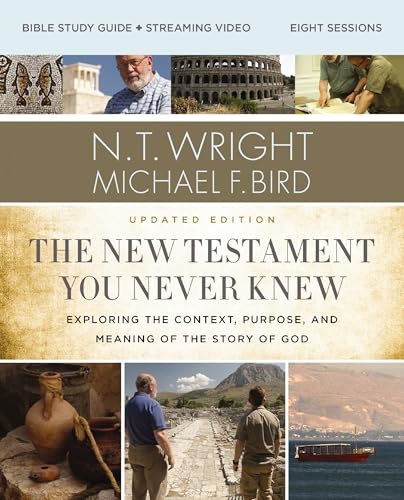
 The New Testament You Never Knew Bible Study Guide plus Streaming Video, Updated Edition by N. T. Wright; Michael F. Bird
ISBN-13: 9780310147046
Paperback: 176 pages
Publisher: HarperChristian Resources
Released: Jan. 20, 2026
Source: ebook review copy from the publisher through NetGalley.
Book Description, Modified from NetGalley:
In this eight-session video Bible study, well-known Bible scholars N. T. Wright and Michael F. Bird team up to take you on a tour of the New Testament. You will discover things you never knew about Jesus' baptism and journey in the wilderness, the meaning behind his parables and miracles, the significance of his death and resurrection, the incredible expansion of the early church into the Greco-Roman world, and how the transforming mission of Jesus can still turn the world upside down today. Through reading the New Testament we continually discover that God indeed keeps his promises, but those promises don't always look like what people expect.
This study guide includes individual access to eight streaming video sessions, group discussion questions, Bible exploration, and video teaching notes, and personal study and reflection materials. Sessions and video run times:
The Books of the New Testament (23:00)
The World of Jesus and the Apostles (20:30)
The Life and Death of Jesus (25:30)
The Resurrection of Jesus (24:00)
The Ministry of the Apostle Paul (25:30)
The Early Christians and the Church (23:00)
The Mission of the Church (26:00)
The Creation of the New Testament (23:30)
My Review:
The New Testament You Never Knew Bible Study Guide is an 8-week-long study providing an overview of the New Testament. This is an updated version and came with online streaming video. You start each session with the group/video. The video was about 20-25 minutes long and showed Bible locations while Wright and Bird provided commentary on that session's topic. The written study guide started each week with a short intro (your choice of one of two questions to discuss for 15 minutes), then there were spaces to write notes under the main topic headlines given in the video with important bits from the video recapped in sidebars. You then discuss the video for 40 minutes with provided questions for group discussion. You finish with 10 minutes for prayer on various prompted points. For each of the 5 days after the group study, you're provided with related verses to look up and asked 2 questions about those verses. You are also provided with a few paragraphs of application at the end of that session. This study covered:
Session 1 - The Books of the New Testament
Session 2 - The World of Jesus and the Apostles
Session 3 - The Life and Death of Jesus
Session 4 - The Resurrection of Jesus
Session 5 - The Ministry of the Apostle Paul
Session 6 - The Early Christians and the Church
Session 7 - The Mission of the Church
Session 8 - The Creation of the New Testament
While this study generally provided a good overview of the New Testament and how the books of New Testament came to be a part of the New Testament, they made a few claims that I didn't agree with. For example, they said that John the Baptist was baptizing in the Jordan River near Jericho because he wanted people to see his ministry as a new Exodus. Well, Exodus refers to leaving...in this case, leaving Egypt. By the time Joshua lead the Israelites across the Jordan, only a few people were left that had been a part of the Exodus. Crossing the Jordan River was entering the land of covenant promise. Also, John preached in other locations as well. Anyway, the visuals chosen for the video were interesting, especially if you knew what they were showing (as they didn't label where every visual was located).
If you've read this book, what do you think about it? I'd be honored if you wrote your own opinion of the book in the comments.

 C is for Creation





 Posts
Posts


